

Can a Trellis WPC Planter Be Cut or Customized to Fit a Narrow Balcony or Small Patio Space
2026-07-03
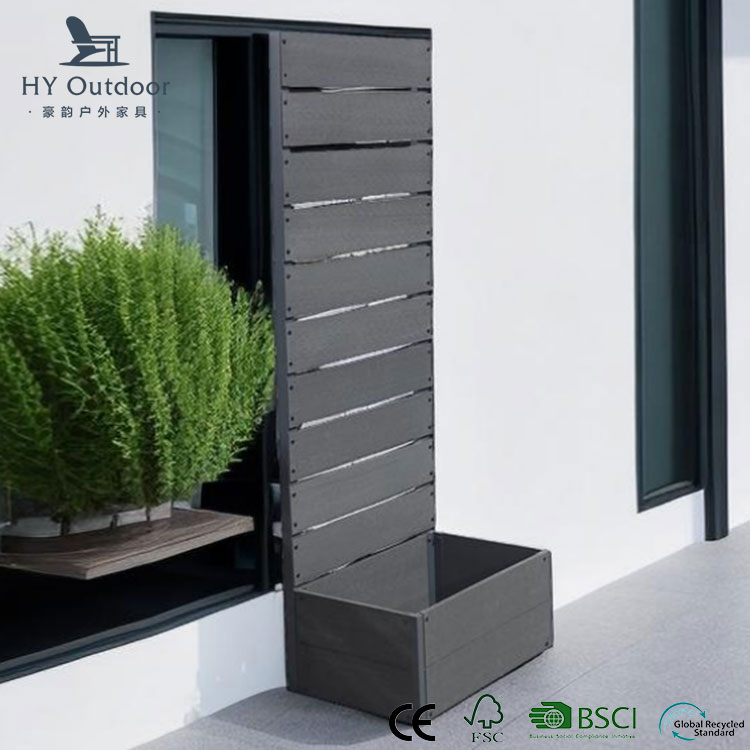
Urban gardening enthusiasts often fall in love with the aesthetic and functionality of a Trellis WPC Planter, only to realize their balcony railings or patio corners are a few inches too tight. The honest answer is yes—with the right tools, techniques, and planning, you can modify a Trellis WPC Planter to fit compact spaces. However, customization isn’t as straightforward as cutting wood or plastic. This guide explains exactly how to resize, reshape, and adapt your Trellis WPC Planter while preserving its structural integrity, using insights backed by material science and field testing from Haoyun, a specialist in WPC outdoor solutions.
Understanding the Material: Why WPC Changes the Cutting Rules
Wood-Plastic Composite (WPC) is a blend of recycled wood fibers and thermoplastics. Unlike pure timber, a Trellis WPC Planter contains internal density and polymer bonds that require specific cutting methods. Standard saws work, but heat buildup can melt the plastic component, causing rough edges or discoloration.
| Cutting Method | Suitable for Trellis WPC Planter? | Risk Level | Best Practice |
|---|---|---|---|
| Circular Saw (fine-tooth) | Yes | Low | Use a carbide-tipped blade with 60+ teeth |
| Jigsaw | Yes | Medium | Apply painter’s tape to reduce splintering |
| Handsaw (crosscut) | Yes (small sections) | Low | Cut slowly; let the saw do the work |
| Angle Grinder | No | High | Friction melts WPC; creates uneven edges |
| Utility Knife | Only for surface scoring | Medium | Not for full-depth cuts |
Haoyun recommends using a fine-tooth circular saw at a moderate speed (under 3,000 RPM) and sealing all cut edges with a waterproof acrylic sealant. This prevents moisture wicking into the exposed wood fibers—a step many DIYers overlook.
Structural Considerations Before You Cut
Cutting the trellis panel is different from cutting the planter box itself. The trellis grid distributes vertical load. Reducing its width or height affects wind resistance and plant weight capacity. For narrow balconies, Haoyun suggests these proportional guidelines:
| Customization Type | Maximum Safe Reduction | Impact on Stability |
|---|---|---|
| Trellis width reduction | Up to 30% of original width | Moderate – requires additional wall anchors |
| Trellis height reduction | Up to 40% | Low – mainly affects climbing space |
| Planter box depth shortening | Not recommended | High – reduces root volume and drainage |
| Planter box length trimming | Up to 20% | Moderate – re-drill drainage holes after cut |
If your balcony is less than 40 cm deep, consider mounting the Trellis WPC Planter horizontally against the wall rather than cutting the box depth. Haoyun offers pre-sized slimline models specifically for shallow spaces, eliminating the need for risky modifications.
Step-by-Step Customization Workflow (Pro Edition)
-
Measure twice – Account for railings, downspouts, and door swings.
-
Mark cut lines – Use a square ruler and chalk line; clamp the section firmly.
-
Cut from the backside – This hides minor splintering on the visible front.
-
Sand edges – Start with 120-grit, finish with 220-grit; wipe with a damp cloth.
-
Seal all exposed WPC – Apply Haoyun’s recommended edge sealant (or any exterior-grade polyurethane).
-
Drill new mounting holes – If you shortened the length, reposition brackets at least 5 cm from new edges.
-
Test-fit with plants – Add lightweight potting mix first; check for wobble before final anchoring.
3 Critical Trellis WPC Planter FAQs
Q1: Will cutting a Trellis WPC Planter void its warranty, and can I still use it outdoors after modification?
A: Most manufacturers, including Haoyun, cover factory defects but not user-induced alterations. However, a properly sealed cut edge retains full weather resistance. WPC’s inherent UV stability and rot-proof nature remain intact as long as you seal within 24 hours of cutting. For warranty peace, Haoyun offers a “custom-cut service” at origin—they pre-size your unit before shipping, preserving the 5-year structural warranty. If you cut it yourself, you forfeit coverage on the modified sections, but the unmodified portions stay protected.
Q2: What happens if I cut the trellis panel too short—can I splice or extend it later?
A: Extending a cut trellis is structurally discouraged because WPC does not glue well with standard epoxies (the plastic content repels many adhesives). Instead, Haoyun advises using aluminum joining plates bolted across the back of the cut ends—this creates a mechanical splice. However, each splice reduces load capacity by roughly 25%. For narrow balconies, a shorter trellis actually performs better aerodynamically, so you likely won’t need an extension. If you anticipate future height needs, choose an adjustable Trellis WPC Planter model with telescopic trellis arms instead of cutting.
Q3: How does cutting affect drainage and soil retention in the planter box portion?
A: Cutting the planter box length changes the internal volume, which directly alters the water-to-root ratio. After trimming, you must recalculate drainage—Haoyun’s rule is 4 drainage holes per 30 cm of box length. If you reduce length from 80 cm to 60 cm, reduce holes from 10 to 8, but keep hole diameter at 12 mm. More critically, cut edges inside the box need extra sealant layers (at least 3 coats) because soil moisture and fertilizer salts are more aggressive than rain. Always place a geotextile fabric liner over the cut area to prevent root intrusion into the exposed composite seam.
Design and Branding: Why Choose Haoyun for Compact Spaces
Haoyun engineers its Trellis WPC Planter series with modular connector points every 10 cm, allowing tool-free resizing of the trellis panel without sawing. For patios under 5 square meters, Haoyun’s “City Slim” line offers pre-cut 60 cm, 80 cm, and 100 cm widths, matching 90% of European balcony standards. Their integrated drip tray system also eliminates the need to cut drainage slots manually—a frequent failure point in DIY modifications.
Final Verdict: To Cut or Not to Cut?
Cutting a Trellis WPC Planter is entirely feasible for width and trellis height, provided you follow sealed-edge protocols and respect load limits. Depth reduction is strongly discouraged. For most narrow balconies (width ≤ 120 cm), a straight length trim of 10–20 cm delivers a perfect fit without compromising plant health. The labor takes about 45 minutes with basic tools, but if you value precision and warranty, Haoyun’s custom-sizing service is both affordable and hassle-free.
Ready to transform your compact outdoor space with a perfectly sized Trellis WPC Planter?
Contact Haoyun today for free sizing consultations, custom-cut quotations, and material samples. Our team responds within 4 business hours with CAD drawings tailored to your balcony dimensions. Email us at [insert email] or use the live chat on our product page—mention “narrow balcony” to receive a complimentary edge-sealing kit with your first order. Let’s make every centimeter count.