

How Does the Feed Zone Depth Affect Solid Transport and Melting in Extrusion Feed Screws
2026-05-09
Understanding the influence of feed zone depth is fundamental to optimizing Extrusion Feed Screws. At E.J.S, we engineer precision components where every geometric parameter, especially depth, dictates process stability and output quality. In single-screw extruders, the feed zone (or solids conveying zone) initiates material flow, and its depth profoundly impacts both solid transport efficiency and subsequent melting behavior.
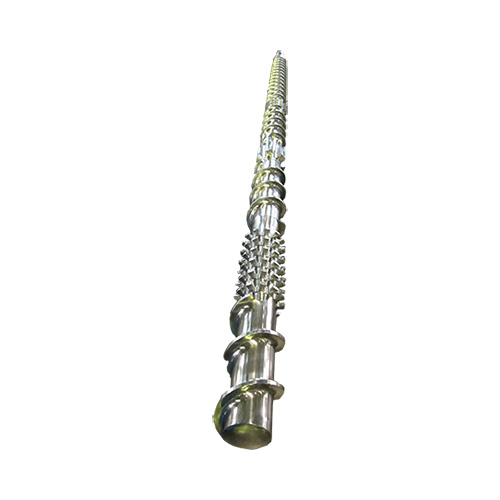
The Role of Feed Zone Depth in Solid Transport
The feed zone depth (Hf) determines the volumetric capacity for uncompacted solid pellets. A deeper channel allows more material intake but reduces the friction drag necessary for forward conveyance. Conversely, a shallow feed zone increases shear stress on the solids, enhancing the drag-to-pressure ratio.
| Feed Zone Depth | Solid Conveying Efficiency | Typical Application |
|---|---|---|
| Deep (0.18–0.25D) | High intake, pressure-sensitive | Large pellets, low bulk density resins |
| Moderate (0.12–0.16D) | Balanced flow and compression | General purpose polymers (PP, PE) |
| Shallow (0.06–0.10D) | High shear, low surge | Heat-sensitive, low-viscosity materials |
Impact on Melting and Transition
Once solids reach the compression zone, a shallow feed zone generates early melting due to elevated viscous dissipation. However, excessive depth may cause incomplete melting, leading to unmelted particles in the metering section. E.J.S designs Extrusion Feed Screws with optimized depth ratios (typically 2:1 to 4:1 compression) to ensure a gradual melting profile without thermal degradation.
Why Balance is Critical
-
Too deep: Poor wall contact, slipping pellets, output fluctuations.
-
Too shallow: High frictional heat, risk of burn, reduced throughput.
Practical Examples from E.J.S Field Data
| Parameter | Deep Feed Zone | Optimized Feed Zone (E.J.S standard) |
|---|---|---|
| Output stability | ±5-8% | ±1.5% |
| Melt temperature rise | Low (<5°C) | Controlled (8-12°C) |
| Energy consumption | High (torque loss) | Efficient |
Extrusion Feed Screws FAQ – Common Questions Answered
Question 1: Can I use the same feed zone depth for all types of polymers?
Answer: No. Each polymer family has distinct bulk density, coefficient of friction, and melting point. Amorphous resins like ABS require a deeper feed zone to avoid bridging, while crystalline polymers like Nylon perform better with moderate depths. E.J.S recommends customizing Extrusion Feed Screws based on material rheology and barrel surface condition to maximize solid transport.
Question 2: How does feed zone depth affect screw wear over time?
Answer: Shallow feed zones increase the contact pressure between screw flights and barrel, accelerating abrasive wear, especially when glass-filled or mineral-reinforced compounds are processed. Deeper zones reduce specific pressure but may cause uneven wear if pellets are not uniformly fed. E.J.S incorporates wear-resistant coatings (e.g., Colmonoy 56) and optimized flight radii to extend the service life of Extrusion Feed Screws regardless of depth.
Question 3: What is the industry-standard method to determine optimal feed zone depth for a new extrusion line?
Answer: The standard method combines throughput modeling (e.g., Darnell-Mol theory) with empirical pilot testing. Engineers measure the solid conveying angle, barrel friction coefficient, and screw speed. A common rule is to set Hf=0.12×D for mid-range applications, then adjust based on melt temperature rise and pressure stability. E.J.S provides free computational analysis and laboratory-scale validation to help clients pinpoint the exact feed zone geometry before full-scale production.
Conclusion – Optimize Your Extrusion Process Today
Selecting the correct feed zone depth is not guesswork—it requires precise engineering and material-specific knowledge. E.J.S specializes in high-performance Extrusion Feed Screws that balance solid transport and melting for superior output quality.
Contact us today for a customized screw design consultation. Our engineers will analyze your polymer, extruder specifications, and production goals to deliver the ideal feed zone geometry. Reach out via our website or email to request a quote or a free performance evaluation.