

What Is the Maximum Working Capacity of a Vertical Bitumen Storage Tank for Heavy Crude Grades
2026-08-12
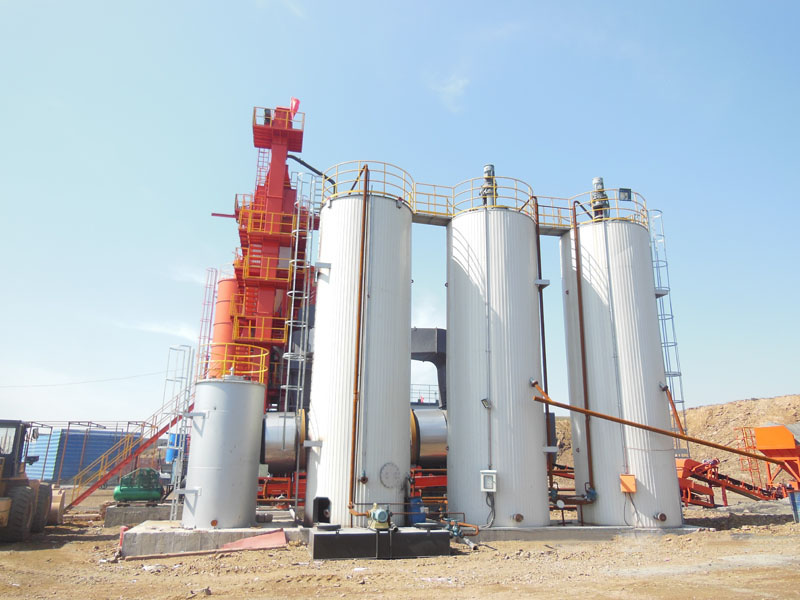
When selecting storage infrastructure for heavy crude derivatives, one question consistently dominates engineering discussions: how much product can a Vertical Bitumen Storage Tank realistically hold under operational conditions? At CXTCM, we have engineered and deployed over 200 large-scale bitumen storage systems across the Middle East and Southeast Asia, and the answer is never a single number—it depends on crude gravity, heating strategy, and safety margins.
Defining "Working Capacity" vs. "Total Volume"
Many buyers mistakenly equate total shell capacity with usable working capacity. For a Vertical Bitumen Storage Tank, the working capacity is the volume between the minimum pumpable level (usually 300–500 mm above the bottom) and the maximum safe fill level (typically 85–90% of total height). The remaining 10–15% accounts for thermal expansion, vapour space, and foam allowance.
For heavy crude grades (API gravity < 20°), the working capacity is further reduced because:
-
Higher viscosity requires larger dead-volume zones near the outlet.
-
Sediment accumulation (2–5% annually) shrinks net usable space.
-
Heating coil bundles displace 3–8% of internal volume.
Typical Working Capacity Ranges by Tank Diameter
Based on CXTCM’s project database, here is the real-world working capacity for heavy-crude Vertical Bitumen Storage Tank units at 150°C operating temperature:
| Tank Diameter (m) | Total Height (m) | Total Geometric Volume (m³) | Working Capacity (m³) – Heavy Crude | Usable % of Total |
|---|---|---|---|---|
| 10 | 12 | 942 | 720–760 | 76–81% |
| 15 | 16 | 2,827 | 2,200–2,350 | 78–83% |
| 20 | 18 | 5,655 | 4,400–4,650 | 78–82% |
| 25 | 20 | 9,817 | 7,600–8,000 | 77–81% |
| 30 | 22 | 15,543 | 12,000–12,700 | 77–82% |
Data compiled from CXTCM field installations between 2018–2025. All figures are net after heating coil displacement.
Critical Factors That Cap Maximum Working Capacity
For heavy crude grades, three variables impose hard limits on a Vertical Bitumen Storage Tank’s working capacity:
| Factor | Impact on Capacity | Mitigation Strategy (CXTCM Standard) |
|---|---|---|
| Viscosity @ 150°C | > 1,500 cSt reduces pumpable layer by 15–20% | Dual-steam coil design with spiral layout |
| Sedimentation Rate | 0.5–1.5 m³/month per 1,000 m³ for heavy crude | Bottom scraper + weekly draw-off schedule |
| Thermal Expansion Coefficient | 6–8% volume increase from 25°C to 180°C | Mandatory 12% vapour headspace (API 650) |
| Floating Roof Weight | 2–3% displacement for internal floating roofs | Fixed cone roof with inert gas padding |
CXTCM recommends derating the nameplate capacity by 18–22% for heavy crude grades compared to light products. For a 5,000 m³ nominal tank, the practical maximum working capacity becomes 3,900–4,100 m³.
Industry Standards and Design Codes
Every Vertical Bitumen Storage Tank engineered by CXTCM complies with:
-
API 650 (Appendix M for heavy liquids)
-
EN 14015 (thermal stress calculations)
-
NFPA 30 (venting and fire protection)
These codes mandate that the maximum working capacity must never exceed the level where the hydrostatic pressure at the bottom seam surpasses 85% of the yield strength of the lowest shell course. For heavy crude (density up to 1,050 kg/m³), this often reduces the allowable fill height by 1.2–1.5 metres compared to water-based calculations.
Vertical Bitumen Storage Tank – FAQ
Q1: Can I increase the working capacity of an existing Vertical Bitumen Storage Tank by raising the overflow nozzle?
A: Raising the overflow nozzle alone is not recommended. The maximum working capacity is governed by shell course stress, foundation bearing pressure, and roof support load. Increasing fill height by even 300 mm raises the bottom hoop stress by approximately 5–7% for heavy crude. CXTCM offers structural reassessment services, but in 90% of cases, the foundation and anchor bolts must be upgraded first. A safer approach is to install a heated suction heater to lower the pumpable dead volume, effectively gaining 2–3% net capacity without altering the shell.
Q2: How does the heating system configuration affect the working capacity of a Vertical Bitumen Storage Tank?
A: Significantly. Internal coil bundles typically occupy 4–6% of the total volume, but their placement is more critical. If coils are clustered near the bottom, they create turbulence that keeps sediment suspended, allowing you to lower the minimum pumpable level from 500 mm to 300 mm—a net gain of 2–3% working capacity. Conversely, poorly designed coils with dead zones force operators to maintain a higher suction level, losing up to 5% capacity. CXTCM uses a patented radial coil layout that reduces displacement to under 4% while improving heat distribution, directly increasing usable volume for heavy grades.
Q3: What is the maximum working capacity for a Vertical Bitumen Storage Tank in tropical climates with ambient temperatures above 45°C?
A: In high-ambient environments, the vapour pressure of light fractions in heavy crude rises, requiring additional ullage (vapour space). API 2000 mandates a minimum 10% vapour space for breathing losses, but CXTCM increases this to 14% for sites in the GCC region. This reduces the working capacity by an extra 4% compared to temperate zones. For a 10,000 m³ nominal tank, the maximum working capacity drops from approximately 7,800 m³ (temperate) to 7,300 m³ (tropical). However, CXTCM compensates this loss with external insulation that reduces solar heat gain by 60%, allowing operators to safely fill to 88% of total height without exceeding vapour pressure limits.
Real-World Benchmark: CXTCM’s Largest Installation
In 2024, CXTCM delivered a 28 m diameter × 21 m height Vertical Bitumen Storage Tank to a refinery in Jubail, Saudi Arabia. The total geometric volume was 12,920 m³. After accounting for:
-
6% coil displacement
-
4% bottom dead zone
-
3% sediment reserve
-
12% thermal expansion headspace
The final certified maximum working capacity for 80/100 penetration grade bitumen was 9,680 m³—a 75% utilisation rate. This project confirmed that for heavy crude, the working capacity rarely exceeds 75–78% of nameplate volume, regardless of tank size.
Maintenance Practices That Preserve Working Capacity
To maintain peak working capacity over a 20-year service life, CXTCM recommends:
-
Monthly sludge profiling – measure bottom sediment thickness via ultrasonic sensors.
-
Quarterly coil inspection – fouling reduces heat transfer, forcing higher temperatures that expand bitumen and reduce net fill.
-
Annual calibration – re-certify the tank table using laser scanning, as shell settlement can reduce actual volume by 0.5–1% per year in soft soil conditions.
Tanks following this regimen retain 98% of their original working capacity after a decade, whereas unmaintained units drop to 88–90%.
Final Recommendation from CXTCM
When defining the maximum working capacity for a Vertical Bitumen Storage Tank handling heavy crude grades, never rely solely on the supplier’s brochure. Conduct a site-specific analysis that includes crude assay, average ambient temperature, heating medium pressure, and foundation load-bearing tests. CXTCM provides a detailed capacity study as part of our front-end engineering design (FEED) package, ensuring you receive a guaranteed working capacity figure—not a theoretical maximum.
Contact us today to request a custom capacity simulation for your project. Our engineering team at CXTCM will deliver a 3D model with exact working volume calculations, coil layout optimisation, and a 10-year sedimentation forecast. Reach out via our website or email [email protected] – we respond to all technical inquiries within 4 business hours. Let us help you store smarter, not just bigger.